



Problem
In semiconductor factories, production orders are transported and stored in special transport containers (e.g. FOUPs, SMIFs, cassettes, boxes). Cleanroom paper, optically printed cards or RFID transponders are used to label these production orders and batches. These labelling methods are used to identify objects and link them to information. Staff in production or logistics can use this information to make allocations and track process steps.
Analogue processes use paper or printed media that must be updated manually, for example by staff writing on them by hand. This takes up working time and can lead to errors, as staff must take the papers and enter the information in the correct place, accurately and legibly. If further changes occur in the process, the details may differ from the current data status.
In an automated semiconductor factory with digital labelling and identification processes, the data is stored and updated in databases. The corresponding link to the production order or batch is established using an RFID transponder or barcode. Identification can take place automatically. However, staff cannot immediately tell from the transport container which order is involved in detail, what its status is, or which subsequent process steps are due, such as the transport destination for the next production step. This requires mobile devices or ID stations with appropriate displays to visualise the information. These must be available and, depending on space constraints and installation costs, cannot be deployed at every location.
Solution
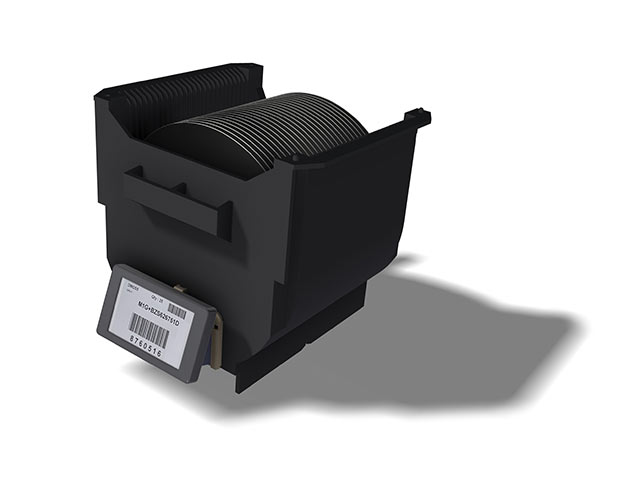
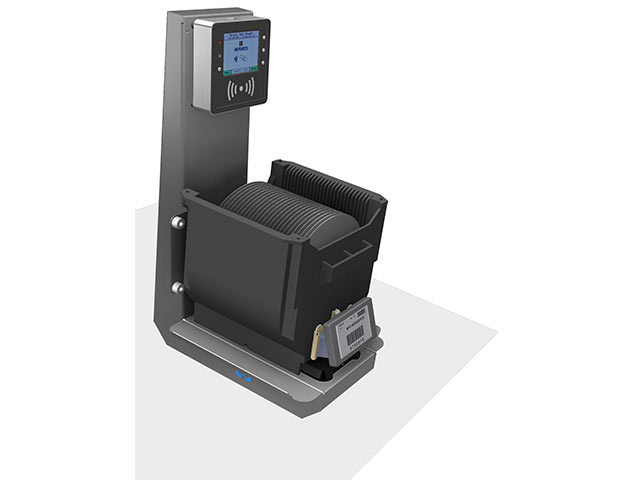
To resolve the issues mentioned above and to digitise and automate analogue processes, HERMOS offers the RFID DISPL(((ID))) solution. This operates passively and requires no external power source, such as batteries. Battery replacement is therefore not necessary. The solution comprises both a passive LF RFID transponder (134.2 kHz) and a coupled, passive E-Ink display for the visual presentation of key information. The E-Ink display draws the energy required to update the display content from the coupled LF transponder, which in turn obtains it from the antenna array of the HERMOS RFID system.
This means that passive RFID technology can be used for the automatic identification of production orders and batches, as HERMOS has been doing for many decades in the semiconductor industry. FOUPs or cassettes can be automatically identified at suitably equipped loading points on the production line, at the load port or in the stocker. Manual identification processes remain possible as well.
The HERMOS RFID DISPL(((ID))) solution can replace paper-based or pre-printed run cards in the processes for which they are intended. As a digital run card, it can be updated via RFID without staff having to amend the contents by hand or reprint the run card. Neither paper nor printing materials are required for this update.
When fully implemented, the solution can also utilise the integrated passive LF transponder (134.2 kHz) for the automatic identification of the production order at the relevant reading point in the process chain. It thus combines automated identification and digital visualisation of the information without the need for a separate battery.

